
Comprehensive heating, ventilation, and air conditioning solutions for commercial and industrial facilities across Northern and Central New Jersey.
KCG Energy Management has been keeping commercial buildings comfortable across New Jersey for over 33 years. We handle heating, ventilation, and air conditioning for everything from single-story retail buildings in Bergen County to multi-floor office complexes in Lyndhurst. Our services cover the full scope of commercial HVAC work — and our team has the field hours to back it up.
We work on the brands on all major commercial: Trane, Lennox, Carrier, Daikin, York, Mitsubishi, Rheem, Reznor and Luxaire. We also handle building automation platforms like Honeywell Tridium and Trane Tracer. If it heats, cools, or moves air in a commercial building, we service it.
Preventative maintenance is the single best investment a building owner can make in HVAC equipment. We design custom PM programs for each facility because a warehouse in Parsippany has different needs than a nursing home in Morristown or a retail building in Paramus.
Our maintenance visits cover the items that matter: system inspections, belt and filter changes, coil cleaning, refrigerant level checks, thermostat calibration, drain line clearing, boiler efficiency tuning, and air balancing. We also offer remote monitoring so we can catch problems before your tenants start calling.
Every PM customer gets the same dedicated technicians at every visit. (See our contractor checklist for facility managers to learn what to expect from your HVAC service provider.) They learn your building, your equipment history, and your quirks. That familiarity means faster diagnoses and fewer surprises on your invoice. Our maintenance programs also include remote monitoring options, so we can keep an eye on your systems between scheduled visits and catch issues before they become emergencies.
Equipment breaks. That is the reality of mechanical systems. When a rooftop unit goes down in July or a boiler fails in January, response time matters. Our dispatch focuses on same day / next day service across Morris County, Bergen County, Essex County, Passaic County, and the surrounding areas of Northern and Central New Jersey.
Our technicians are experienced troubleshooters. We handle leak detection and repair, compressor and component replacement, system defrost issues, refrigerant recovery and recharging, pulley alignment, combustion analysis, and building automation troubleshooting.
Whether it is a straight equipment swap on an aging rooftop unit or a new build-out, our installation team handles projects from end to end. We size equipment properly — oversized systems short-cycle, waste energy, and wear out faster. Undersized systems cannot keep up on the hottest and coldest days.
We install rooftop units, split systems, heat pumps, boilers, chillers, makeup air units, and building automation systems. We also handle VRF/VRV installations for buildings that need flexible, zone-by-zone climate control. For projects that qualify, we can tie in NJ Direct Install rebates and advanced custom utility incentives to offset your upfront costs.
Our commercial HVAC work spans a wide range of equipment and building types:
Equipment: Rooftop units (RTUs), split systems, heat pumps, boilers, chillers, makeup air systems, clean room HVAC, VRF/VRV systems, and building automation controls.
Building types: Office buildings, warehouses, pharmaceutical facilities, server rooms, supermarkets, department stores, schools, banks, nursing homes, religious buildings, and retail centers.
Manufacturers: Carrier, Trane, Daikin, York, Lennox, Mitsubishi, Reznor, Luxaire, McQuay, Liebert, Airedale, and Lochinvar.
Our dispatch covers a wide swath of Northern and Central New Jersey. We have regular accounts in Morristown, Parsippany, Wayne, Totowa, Pine Brook, Montville, Towaco, Lincoln Park, Pompton Plains, Fairfield, Caldwell, and throughout Morris County. In Bergen County, we service buildings in Paramus, Hackensack, Teaneck, Englewood, Mahwah, Ramsey, and Ridgewood. In Essex County, we work in Livingston, West Orange, Montclair, and Newark. In Passaic County, we cover Wayne, Clifton, Paterson, and Pompton Lakes.
We also serve parts of Union, Hudson, and Sussex counties depending on the scope of the project. If you are within a reasonable distance of the Route 80 corridor, chances are good that we are already servicing buildings near you.
We are a veteran-owned company based in Moonachie, NJ. Our office is at 500 W Commercial Ave in Moonachie. We are not a national franchise sending a different face every visit. We are local technicians who live in the same counties we serve.
Thirty-three years in this business means we have seen every type of failure, every manufacturer’s weak spot, and every shortcut that comes back to haunt a building owner. That experience is what you get when you call 973-335-3884.
In many cases, yes. Modern VRF heat pump systems from Trane, Mitsubishi, and Daikin are rated to operate in temperatures as low as -22°F to -31°F, which covers even the worst NJ winters. They work especially well in multi-zone buildings like offices, schools, and medical facilities where different areas need different temperatures. That said, VRF is not always a straight swap for a boiler. If your building relies on hydronic radiant heat or has a central steam system, a boiler replacement or hybrid approach may still make more sense. We evaluate the building, the existing distribution system, and the operating costs before recommending VRF over a traditional boiler replacement.
Start with the basics: make sure the thermostat is calling for heat and the unit is in heating mode. Beyond that, the most common causes we see are dirty or clogged burners, a tripped high-limit safety switch, a faulty ignition system (especially hot surface ignitors — they crack over time), or a cracked heat exchanger. If you have a heat pump RTU, frozen outdoor coils or a failed defrost board are common culprits in NJ winters. Any issue involving gas components or heat exchangers should be handled by a licensed technician — call us at 973-335-3884 and we can usually get someone on site the same day.
A well-maintained commercial RTU typically lasts 15 to 20 years. Once a unit passes the 15-year mark, repair costs tend to accelerate — especially compressor and heat exchanger failures. We generally recommend replacement when repair costs exceed 40 to 50 percent of the cost of a new unit, or when the unit can no longer maintain comfortable temperatures reliably. If you are still running R-22 equipment, replacement should be on your radar now, since R-22 refrigerant is no longer manufactured and the remaining supply is expensive. We can assess your existing units and give you a phased replacement plan that spreads the cost over multiple budget cycles.
Uneven temperatures are one of the most common complaints in commercial buildings and usually come down to one of a few things: a zoning or controls issue where dampers are not modulating correctly, undersized or unbalanced ductwork, a rooftop unit that is short-cycling and not running long enough to condition the space, or solar heat gain on one side of the building. We start with a walkthrough and take temperature and airflow readings at multiple points. In many cases, the fix is a controls adjustment or a damper repair — not a full system replacement.
It depends on the age and refrigerant type. If the unit is under 10 years old and uses a current refrigerant like R-410A or R-454B, a leak repair is usually the right call — we locate the leak, repair it, pressure-test the system, and recharge. If the unit is 15-plus years old and uses R-22, and has an unrepairable leak on the coil the math changes fast. R-22 is extremely expensive now, and a $5K coil replacement should make you at least consider replacement vs repair.
It can be. Grinding or squealing noises usually point to a failing bearing in the blower motor or a worn belt — both are relatively inexpensive fixes if caught early but can cause major damage if ignored. Banging sounds often indicate a loose component inside the air handler or a compressor that is starting to fail. A constant hum or buzz from the electrical panel could be a contactor going bad. The bottom line: new noises should be investigated promptly. What sounds minor today can become a compressor replacement tomorrow.
The EPA is phasing down production of R-410A under the AIM Act, with significant reductions starting in 2025. R-410A is not being banned outright — existing equipment can continue using it, and reclaimed refrigerant will still be available. However, the cost of virgin R-410A is rising as supply tightens. If you are buying new equipment, most manufacturers are transitioning to R-454B (marketed as Puron Advance by Carrier) and R-32. If your current equipment is under 10 years old, there is no urgency to replace it. If you are planning replacements in the next few years, it makes sense to specify equipment using the newer refrigerants so you are not locked into a shrinking supply chain.
Common signs include rooms that never reach set temperature, excessive noise at registers, and RTUs that run constantly without satisfying the space. Ductwork leaks are especially common in older NJ commercial buildings — joints separate over time, flex duct connections deteriorate, and roof penetrations shift with thermal expansion. We test duct systems using static pressure measurements and airflow readings at each diffuser. A system losing 20 to 30 percent of its air to leaks is not unusual, and sealing those leaks often improves comfort more than replacing the equipment.
An economizer is a damper system on your rooftop unit that brings in cool outside air for free cooling when conditions allow — typically in spring and fall in NJ. It reduces compressor run time and saves energy. The problem is that economizers are exposed to the elements on the roof and their components — actuators, linkages, damper blades, and enthalpy sensors — corrode, seize, and fail regularly. A stuck-open economizer in winter can freeze pipes and drive heating bills through the roof. A stuck-closed economizer wastes energy in mild weather. We check economizer operation at every PM visit because catching a failure early saves our clients real money.
Yes, and it is one of the highest-impact energy upgrades available. Electric resistance heat strips are essentially giant toasters — they convert electricity to heat at a 1:1 ratio. A modern heat pump delivers 2.5 to 3.5 times as much heat per unit of electricity because it moves heat from outside air rather than generating it. In NJ, where electric rates are among the highest in the country, this can cut your winter heating costs by 50 to 65 percent. The conversion typically involves replacing the RTU or adding a heat pump section. We handle the full project including electrical upgrades and controls integration.
There is no reliable rule of thumb — proper sizing requires a Manual N or equivalent commercial load calculation that accounts for the building envelope, insulation levels, window area and orientation, occupancy, internal heat loads from lighting and equipment, and ventilation requirements. An oversized unit short-cycles and fails to dehumidify. An undersized unit runs constantly and never catches up on hot days. We perform load calculations for every replacement to make sure the equipment matches the actual building, not just the tonnage of whatever was there before.
Repeated breaker trips on a commercial RTU almost always indicate an electrical issue that needs immediate attention. The most common causes are a compressor drawing locked rotor amps due to a failing motor or a seized bearing, a short in the wiring or contactor, a condenser fan motor pulling excessive current because of a bad capacitor, or a breaker that has weakened over time and trips at lower-than-rated current. Do not simply reset the breaker and hope it stops — a compressor pulling high amps can overheat wiring and create a fire risk. Call us and we will diagnose the root cause before re-energizing the unit.
A makeup air unit brings in fresh outdoor air, conditions it (heats or cools it), and delivers it into the building to replace air being exhausted. Any commercial kitchen, manufacturing facility, or space with exhaust fans needs makeup air — otherwise the building goes into negative pressure, which makes doors hard to open, causes drafts, and can backdraft gas appliances dangerously. NJ code requires balanced ventilation in most commercial occupancies. If you have kitchen hoods, paint booths, or process exhaust, a properly sized MAU is not optional. We size and install MAUs that integrate with your existing HVAC so the building stays comfortable and code-compliant.
A packaged rooftop unit (RTU) contains everything — compressor, condenser, evaporator, and air handler — in a single cabinet on the roof. It connects to the building via ductwork through a roof curb. A split system separates the condenser (outside) from the air handler (inside), connected by refrigerant lines. RTUs are the standard for single-story commercial buildings because they keep all the equipment on the roof and out of usable space. Split systems are common in multi-story buildings or spaces where rooftop placement is not practical. We install and service both configurations.
Musty smells in a commercial HVAC system almost always mean biological growth — mold, mildew, or bacteria — somewhere in the system. The most common locations are the evaporator coil and drain pan (standing water plus organic debris is a perfect growth environment), the interior lining of ductwork, and dirty or wet filters. Beyond the unpleasant smell, this is an indoor air quality issue that can trigger occupant complaints and health concerns. The fix involves cleaning and treating the coil and drain pan, inspecting ductwork, upgrading filtration, and in some cases installing UV germicidal lights. Regular PM visits catch this early before it becomes a tenant or employee issue.
NJ follows the International Mechanical Code (IMC) and International Energy Conservation Code (IECC), which set requirements for ventilation rates, equipment efficiency minimums, ductwork sealing, refrigerant handling, and energy recovery. Any new installation or major replacement in NJ requires a permit and inspection. Efficiency minimums have increased significantly — a new RTU must meet current ASHRAE 90.1 standards, which are stricter than what was required even five years ago. We handle all permitting, code compliance, and inspections as part of our installation work so you do not have to navigate the process yourself.
Shut down the affected equipment immediately to prevent electrical damage or compressor failure from water intrusion. Water in an air handler can short electrical controls, corrode contactors and relays, and saturate insulation. If the RTU is on the roof and a curb seal failed, water may have entered the ductwork as well. Call us for an emergency inspection — we will assess the damage, determine what can be dried out and restored versus what needs replacement, and document everything for your insurance claim. Time matters because standing water in ductwork creates mold growth within 48 to 72 hours.
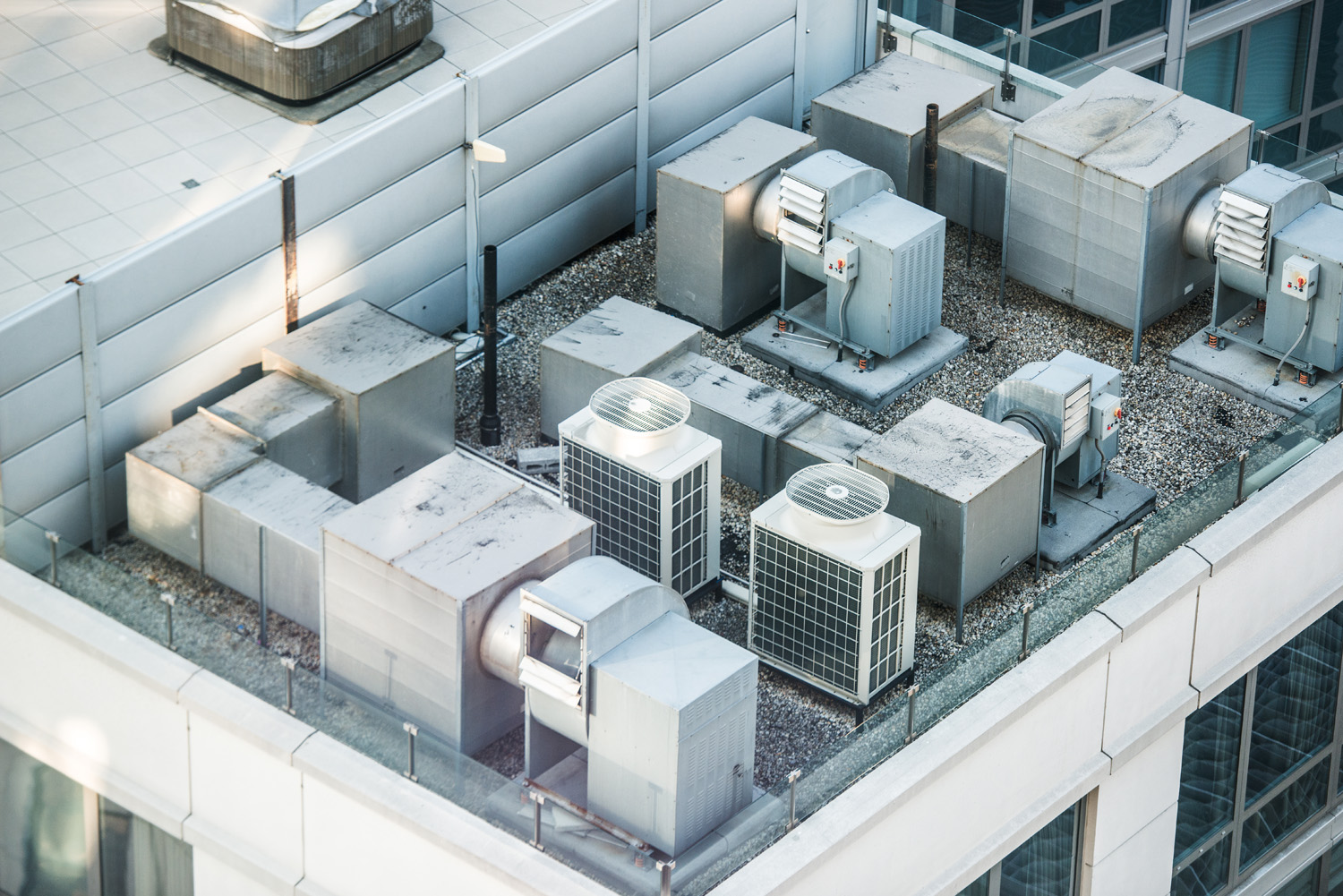
Our commercial HVAC work spans a wide range of equipment, building types, and manufacturers.
Rooftop units (RTUs), split systems, heat pumps, boilers, chillers, makeup air systems, clean room HVAC, VRF/VRV systems, and building automation controls.
Office buildings, warehouses, pharmaceutical facilities, server rooms, supermarkets, department stores, schools, banks, nursing homes, religious buildings, and retail centers.
Carrier, Trane, Daikin, York, Lennox, Mitsubishi, Reznor, Luxaire, McQuay, Liebert, Airedale, and Lochinvar.

Our dispatch covers a wide swath of Northern and Central New Jersey, with regular accounts across all eight counties in our service area.
Morristown, Parsippany, Pine Brook, Montville, Towaco, Lincoln Park, Pompton Plains, Denville, Dover, Randolph, Rockaway, Boonton, Butler
Paramus, Hackensack, Teaneck, Englewood, Mahwah, Ramsey, Ridgewood, Fort Lee, Fair Lawn, Garfield, Lodi, Bergenfield
Livingston, West Orange, Montclair, Newark, Bloomfield, Nutley, Caldwell, Fairfield, Maplewood, Millburn, Verona, Cedar Grove
Wayne, Totowa, Clifton, Paterson, Pompton Lakes, Little Falls, Woodland Park, West Milford, Ringwood, Haledon, Hawthorne
Jersey City, Hoboken, Secaucus, North Bergen, Bayonne, Union City, West New York, Kearny, Harrison, Weehawken
Freehold, Red Bank, Long Branch, Middletown, Holmdel, Tinton Falls, Eatontown, Asbury Park, Marlboro, Manalapan
Edison, New Brunswick, Woodbridge, Piscataway, Perth Amboy, South Brunswick, East Brunswick, Old Bridge, Sayreville, Metuchen
Elizabeth, Union, Cranford, Westfield, Summit, Linden, Rahway, Scotch Plains, Springfield, Clark, Kenilworth